Best Sous Vide Cookers
The Guide · Sous Vide Cookers for Home Cooks

Sous vide listings sell a tenth of a degree. It decides almost nothing.

Read a page of sous vide listings and one figure keeps coming back: 0.1°C. Inkbird, InkSous, CharMeter, Rocyis and PanalChef all print it, and three of those listings set it beside 1°F, which is not the same number. Anova and Breville lead with other things. Holding a water bath steady is the easy part of this appliance, and a few tenths of a degree either way will not turn a medium-rare steak into a medium one. What separates a starter cooker from a serious one is how much water its heater can bring up to temperature and how fast, whether you can run it without a phone, what it does when the water drops on a long cook, and how it fits the pot you own. We compared published specifications and current Amazon prices for 25 sous vide circulator listings sold in the US.

By Ilane Tall6 picks · 25 cookers comparedResearch-based — no testing lab, no invented scores

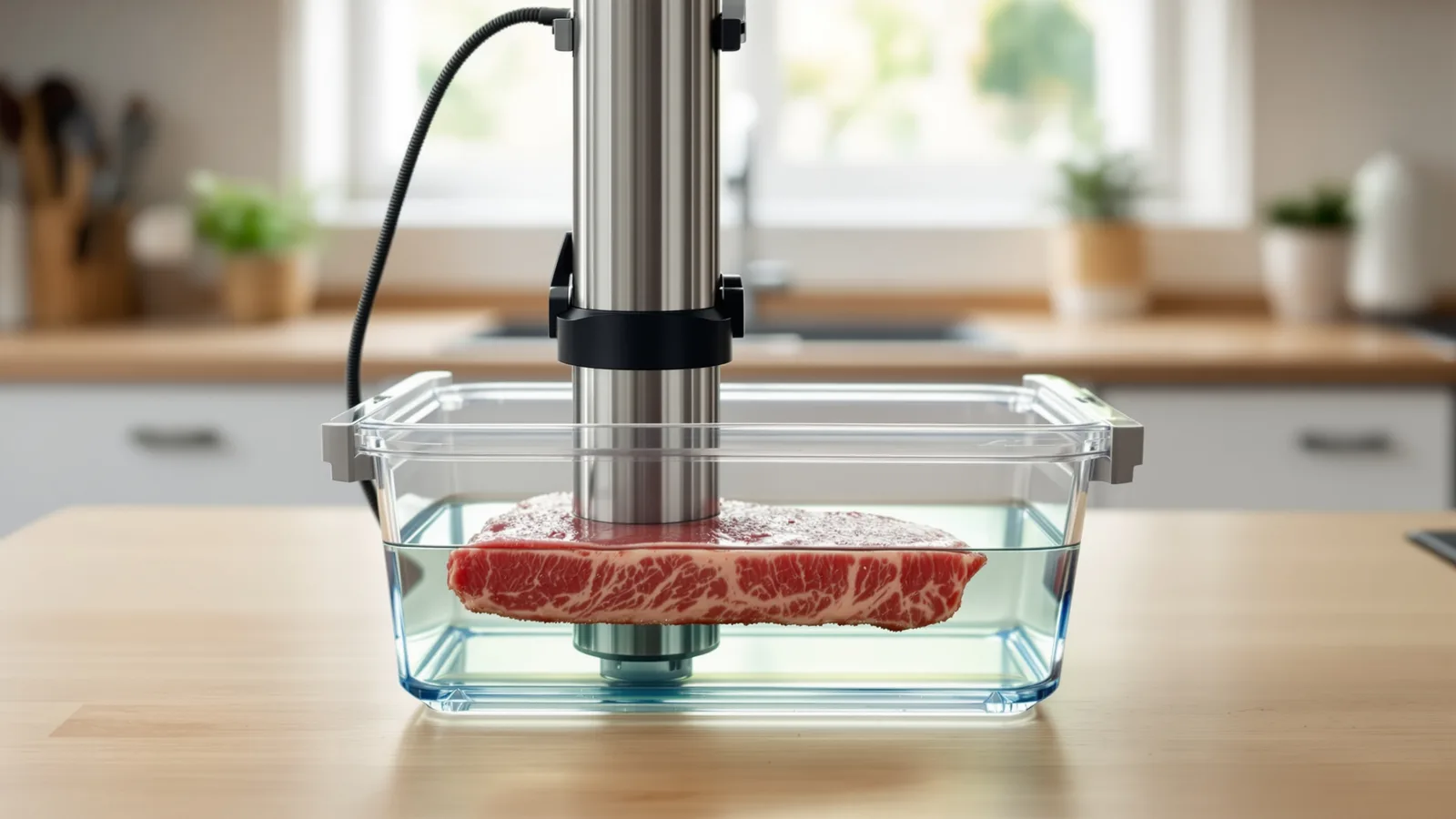
Stainless steel sous vide immersion circulator clamped in a clear water container with a ribeye steak submerged beside it on a kitchen counter
The one to buy

Anova Precision Cooker 3.0

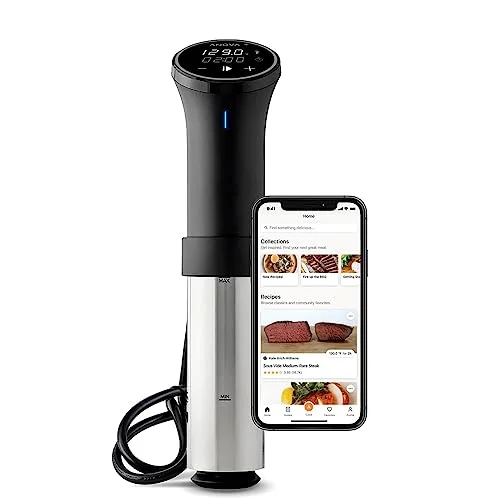
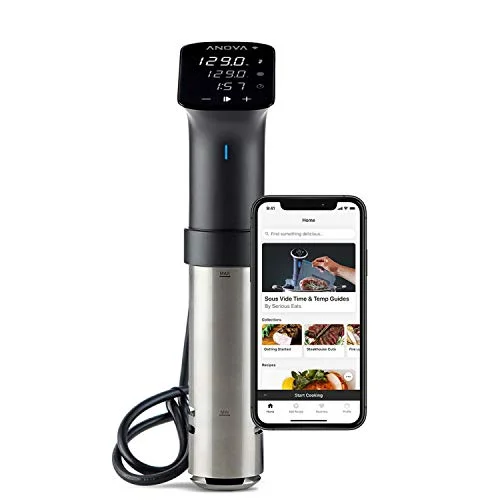
This is the third generation of the circulator Anova first launched in 2014, and its two upgrades fix what most often gets in a home cook’s way. The Wi-Fi is now dual-band, so it can join a 5 GHz network as well as the 2.4 GHz band most budget Wi-Fi cookers here are limited to. And a two-line touch screen on the unit shows time and temperature together, so the phone is not the only window onto the cook.

The rest is practical detail. The 1,100-watt heater is in line with most full-size cookers here. The adjustable clamp fits nearly any pot deep enough for the minimum water line, and the stainless steel skirt on the lower half twists off for washing by hand or in the dishwasher.

The honest caveat: the listing details we compared give no temperature range, no accuracy figure and no maximum bath volume. The missing precision figure does not worry us; the missing bath figure means you should not plan a party-sized cook in a big container on assumption — the Pro below states its number. Check the minimum water depth against your stockpot too, because it is not given here.

1,100 watts·Dual-band Wi-Fi·Two-line touch screen·Dishwasher-safe skirt
Anova Precision Cooker 3.0 Wi-Fi sous vide immersion circulator in stainless steel
Price
$112.23
Check price on Amazon →

Prices change. We refresh them, but Amazon is the authority.

Before you buy

Four things decide this purchase. The precision figure is not one of them.

Watts against liters, not watts alone

On a circulator, wattage is honest: it is the heater’s output, and it sets how fast a bath reaches temperature and how quickly it recovers when cold food goes in. Water needs about 4.2 kilojoules per liter for each degree Celsius, so ten liters from cold tap to steak temperature takes close to half an hour at 1,000 watts, before any heat escapes. Read the figure next to the bath the maker names: Inkbird rates its 1,000-watt ISV-100W for 15 liters, CharMeter for 20, and Anova says its 1,200-watt Pro heats up to 100 liters in a covered container.

An app, a screen or a dial

Some cookers are built around the phone. Breville describes the Joule Turbo as powered by the Joule App, and the Anova Mini’s own three-step instructions end with pressing start in the app. Others pair the app with a touch screen on the unit, as the Anova 3.0 and Inkbird ISV-100W do. Greater Goods has one dial and no app, Wi-Fi or Bluetooth at all. Remote control earns its place on long cooks; an app-first design makes the app part of the product for as long as you own it. And most budget Wi-Fi cookers connect on 2.4 GHz only.

What happens on a two-day cook

Short ribs and pork shoulder spend a day or more in the bath, and the water evaporates as they do. Most cookers here run a timer to 99 or 100 hours, so the clock is rarely the limit; what matters is what the cooker does when the level drops. Inkbird says its ISV-200W stops and sounds an alarm below the minimum line, Sousvide Art lists a water level sensor, and Embenly lists overheat protection that cuts power on a dry run. Plenty of listings say nothing. Whatever you buy, a lid slows the loss — Rocyis sells a kit with one included.

Clamp, depth and what touches the water

Every circulator needs a minimum depth of water to run, so a tall unit wants a deep pot. The Anova 3.0 uses an adjustable clamp, the Anova Nano a fixed one, and Breville’s commercial Creative Series a rugged clamp for anything from a stockpot to a large food-safe container. Below the waterline, KitchenBoss says the parts of its G300 cookers that touch water are SUS304 stainless steel; the Anova Pro, Inkbird ISV-300W and KitchenBoss list IPX7 waterproofing; the Nano’s listing describes a plastic body. None of it changes how the food cooks. It changes how the cooker cleans, and what a slip into the bath does to it.

Side by side

The six, compared

CookerBest forHeaterTemp rangeControlsRated bathPriceGet it
Anova Precision Cooker 3.0 Most kitchens 1,100 W Not listed Touch screen + dual-band Wi-Fi Not listed $112.23 Get it
Inkbird ISV-100W Wi-Fi for less 1,000 W 77–210°F Touch screen + 2.4 GHz Wi-Fi 15 L $69.99 Get it
Greater Goods 1100W No phone needed 1,100 W 68–203°F Single dial, no app 15 L $79.99 Get it
Breville Joule Turbo App-guided cooks 1,100 W Not listed Joule app, Wi-Fi Not listed $149.95 Get it
Anova Precision Cooker Pro Big baths, heavy use 1,200 W Not listed Anova app 100 L, covered $199.00 Get it
Sousvide Art 15-Bag Kit Starting from scratch 1,000 W 32–203°F Touch panel Not listed $46.95 Get it
The six

Our picks, and who each one is for

01Best overall

Anova Culinary Precision Cooker 3.0 (Wi-Fi)

Best for most home cooks

1,100 watts·Dual-band Wi-Fi·Two-line touch screen·Removable stainless skirt

The safe default, for practical reasons. Anova names two upgrades in this third generation: dual-band Wi-Fi, which can join a 5 GHz network as well as the 2.4 GHz band, and a two-line touch screen that shows time and temperature together. The 1,100-watt heater is in line with most full-size cookers here. An adjustable clamp fits nearly any pot that meets the minimum water depth, and the stainless steel skirt on the lower half twists off for the dishwasher. What this listing does not publish is a temperature range or a bath size, so for very large containers, look at the Pro further down.

The one to buy if you want a screen on the cooker and Wi-Fi that will not argue with your router.

Anova Precision Cooker 3.0 Wi-Fi sous vide circulator
Price
$112.23
Check price →
02Best value

Inkbird ISV-100W Wi-Fi Sous Vide Cooker

Best for Wi-Fi control at a lower price

1,000 watts·77–210°F·Up to 15 liters·99-hour timer

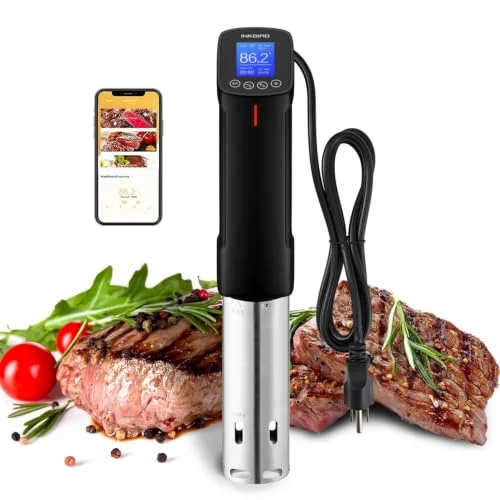
Inkbird publishes more checkable numbers for this cooker than Anova does for the 3.0. A 1,000-watt heater rated for up to 15 liters. A range of 77 to 210°F with a stated accuracy of 0.1°C (0.2°F), one of the few listings where the two units agree. A timer to 99 hours, an LCD touchscreen, a calibration function, 14 preset recipes and a noise claim of under 40 dB. The Inkbird app starts, stops, adjusts and monitors a cook remotely. Two limits: the Wi-Fi is 2.4 GHz only, and this listing says nothing about shutting off when the water runs low — the ISV-200W’s does.

Most of what the premium cookers do, with more of it written down. Check that your router offers a 2.4 GHz band first.

Inkbird ISV-100W Wi-Fi sous vide cooker in black
Price
$69.99
Check price →
03Best without an app

Greater Goods 1100W Sous Vide Cooker (No App)

Best if you would rather leave your phone out of it

1,100 watts·68–203°F·Single-dial control·Built-in calibration

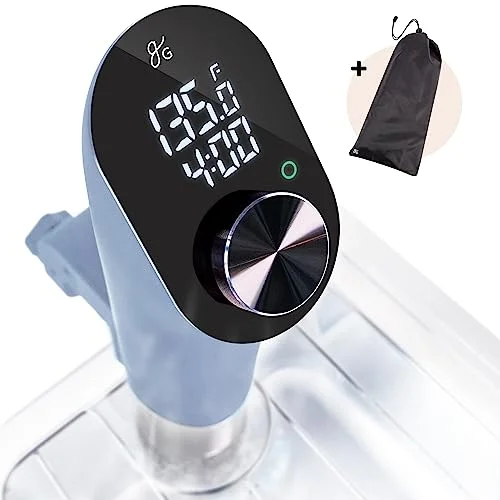
Built for the cook who does not want another account. Temperature and time are set with a twist and press of one dial; there is no app, Wi-Fi, Bluetooth or pairing. The bright LED display is angled at 45 degrees toward you, so it reads from the counter. The range runs from 68 to 203°F in half-degree steps, with a tenth-of-a-degree readout and calibration against a thermometer you trust. The 1,100-watt heater is rated for baths up to 15 liters, and the listing names a brushless motor and a stainless steel cover. The trade is plain: no phone alerts, and no checking a two-day cook from work.

For anyone who wants sous vide to work like an oven dial, this is the cleanest answer on the page.

Greater Goods 1100W sous vide cooker in stone blue with single control dial
Price
$79.99
Check price →
04Best app-guided

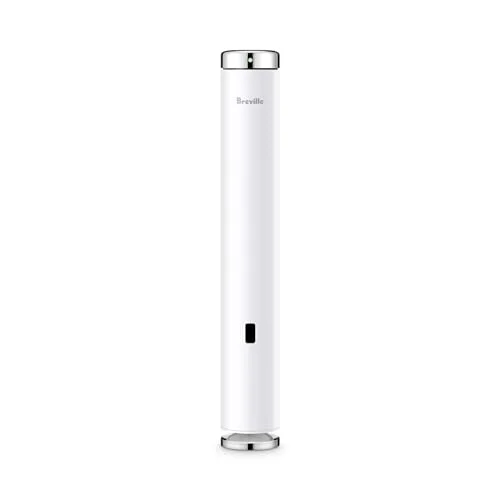
Breville Joule Turbo Sous Vide (BSV600PSS)

Best for cooks who want the app to do the thinking

1,100 watts·Wi-Fi, Joule app·Turbo mode·Polished stainless steel

The clearest example of the app-first approach. Breville describes the Joule Turbo as powered by the Joule App, with an Autopilot mode that runs the cook and a Visual Doneness feature that lets you choose a result — rare, medium, well done or between — instead of a number. Turbo, the headline, is Breville’s claim to cook proteins such as steak, chicken and fish in half the time, using algorithms and cloud computing. The caveat is the design: the listing frames every function through the app, Turbo leans on the cloud by the maker’s own account, and no temperature range or bath size is given.

Excellent if you like being guided and trust your Wi-Fi. If you would rather set a number and walk away, look elsewhere.

Breville Joule Turbo sous vide circulator in polished stainless steel
Price
$149.95
Check price →
05Best for big batches

Anova Culinary Precision Cooker Pro

Best for large baths and heavy, frequent use

1,200 watts·Up to 100 L, covered·Stainless, IPX7·10,000-hour run claim

Anova calls the Pro the most substantial circulator in its lineup, durable enough for a restaurant kitchen. The figures support the pitch: a 1,200-watt heater the maker says can heat up to 100 liters of water in a covered container, and a claim that it can run for a minimum of 10,000 hours straight. The body is stainless steel with an IPX7 waterproof designation, and Anova says it keeps cooking after a drop to the floor or a dunk under water. The Anova app adds recipes and remote monitoring. Note the condition on that 100-liter figure — covered — and that this listing gives no temperature range.

Overkill for a weeknight steak. For a party-sized bath, or a cooker that runs most days, the one built for it.

Anova Precision Cooker Pro sous vide circulator in black and silver
Price
$199.00
Check price →
06Best starter kit

Sousvide Art 1000W Sous Vide Cooker Kit (15 Bags)

Best for starting from nothing, bags included

1,000 watts·32–203°F·15 reusable bags + hand pump·Water level sensor

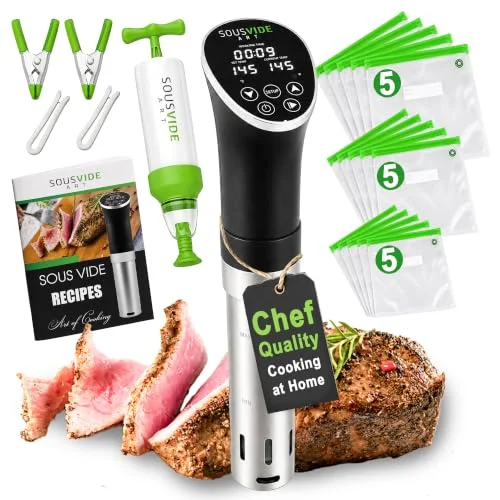
Sous vide needs more than a circulator, and this kit puts most of the rest in the box: 15 reusable vacuum bags in three sizes, a hand pump, two clamps that hold bags on the pot rim, two sealing clips and a recipe book. The cooker has 1,000 watts, a PTC ceramic heating element, a touch panel, a range of 32 to 203°F, a timer to 99 hours 59 minutes and a water level sensor. Its stated tolerance of ±0.5°C is looser than others claim, for reasons explained above. No Wi-Fi is described. A 30-bag version exists, but its listing names a stainless steel heating element, so the two may differ.

The lowest-friction way to find out whether sous vide becomes a habit, with everything but the pot included.

Sousvide Art 1000W sous vide cooker kit with vacuum bags and hand pump
Price
$46.95
Check price →
Our method

How we picked — and what we can’t tell you

What we did

Specs, prices and manufacturer data

We compared published specifications and current Amazon prices for 25 sous vide circulator listings, then kept the cookers whose makers publish something checkable: a heater wattage, a temperature range, a rated bath volume, a timer limit, a control method. One listing had no current price and could not be a pick. We treated the accuracy figure with suspicion, because nearly every budget listing claims the same one and several contradict themselves, and weighted heating power against bath size, control, build and long-cook protection far above anything in the product copy.

What we didn’t

We don’t run a testing lab

We do not physically test these cookers, we do not own them, and we do not publish invented scores out of ten. We also have no verified rating data for this category, so this site publishes no ratings of any kind — we would rather show nothing than make something up. How a heater and pump hold up after hundreds of hours in hard water, or whether an app still works after its maker’s next update, cannot be answered by anybody who has had a cooker for a fortnight. What we can do honestly is read every specification, compare them, and explain the physics behind them.

Go deeper

The guides behind the picks

FAQ

Common questions

Is a more expensive sous vide cooker more accurate?

Not in any way the listings let you prove. Budget cookers from Inkbird, CharMeter and Rocyis claim 0.1°C, while the listings we compared for the Anova 3.0, the Anova Pro and Breville’s cookers give no accuracy figure at all. Some claims contradict themselves: 0.1°C is about 0.18°F, yet three listings print it beside 1°F. For steak, chicken and fish, a few tenths of a degree make no visible difference; eggs are the most sensitive thing you will cook this way. If precision matters, pick a cooker with calibration — Greater Goods, Inkbird and InkSous list it — and check it against a trusted thermometer.

How many watts does a sous vide cooker need?

For a typical home bath, the 1,000 to 1,100 watts most cookers list is enough. Here wattage is the heater’s real output, so it decides speed: water needs about 4.2 kilojoules per liter per degree Celsius, which puts ten liters from cold tap to steak temperature at roughly half an hour on 1,000 watts, and nearer twenty minutes on the 1,450-watt Breville HydroPro, before heat losses. The 850-watt Anova Mini takes longer and recovers more slowly when cold food goes in. Hot tap water and a lid help any of them.

Do I need Wi-Fi on a sous vide cooker?

No. A circulator cooks the same with or without it; Wi-Fi changes how you check on it. It earns its place on long cooks — a two-day short rib, an overnight pork shoulder — when you want to see or adjust the bath from another room. It also costs something: an account, an app that has to keep working, and on most budget models a 2.4 GHz-only connection that some routers need a setting changed to accept. The Greater Goods cooker on this page has no app, Wi-Fi or Bluetooth at all.

Do I need a vacuum sealer for sous vide?

Not to start. Heavy zipper freezer bags work for most cooks if you lower the open bag slowly into the water until the pressure pushes the air out, then seal it — the water displacement method. A vacuum sealer earns its keep on long cooks and at higher temperatures, where zipper seams can soften. Kits split the difference: Sousvide Art includes reusable bags and a hand pump, and Inkbird sells its Wi-Fi cookers bundled with a countertop sealer and a bag roll. Whatever you use, choose bags made for cooking and clip them to the pot rim.

What pot or container do I need for sous vide?

Any pot deep enough to reach the cooker’s minimum water line and wide enough for water to circulate around the food. A large stockpot is fine for one or two steaks; for bigger cooks, a plastic container made for hot water holds more. Makers state how much their heaters can handle: 15 liters for the Inkbird ISV-100W and Greater Goods, 20 for CharMeter and, covered, 100 for the Anova Pro. A lid matters on anything longer than a few hours. Rocyis sells a kit with a lid but, as its listing notes, no container.

How long does sous vide take?

Longer than a pan, but mostly hands-off. Time depends on thickness more than weight, because heat has to reach the center: a one-inch steak typically needs about an hour, a thick chop or chicken breast longer, and tough cuts like short ribs or brisket a day or more to turn tender. Most cookers here run a timer to 99 or 100 hours. Breville says the Joule Turbo’s Turbo mode cooks proteins in half the time; that is the maker’s claim, and it works through the app. A quick sear afterward gives the outside its color.

Is sous vide cooking safe?

It can be, when you follow published time-and-temperature guidance. The USDA’s safe minimum internal temperatures are 145°F for whole cuts of beef, pork, lamb and veal with a three-minute rest, 145°F for fish, 160°F for ground meat and 165°F for poultry. Sous vide recipes often cook below those figures and rely on holding food at temperature long enough to pasteurize it, which only works with tables matched to the food’s thickness. Do not leave raw food in the 40–140°F danger zone for more than two hours. This is general information, not medical or food-safety advice.